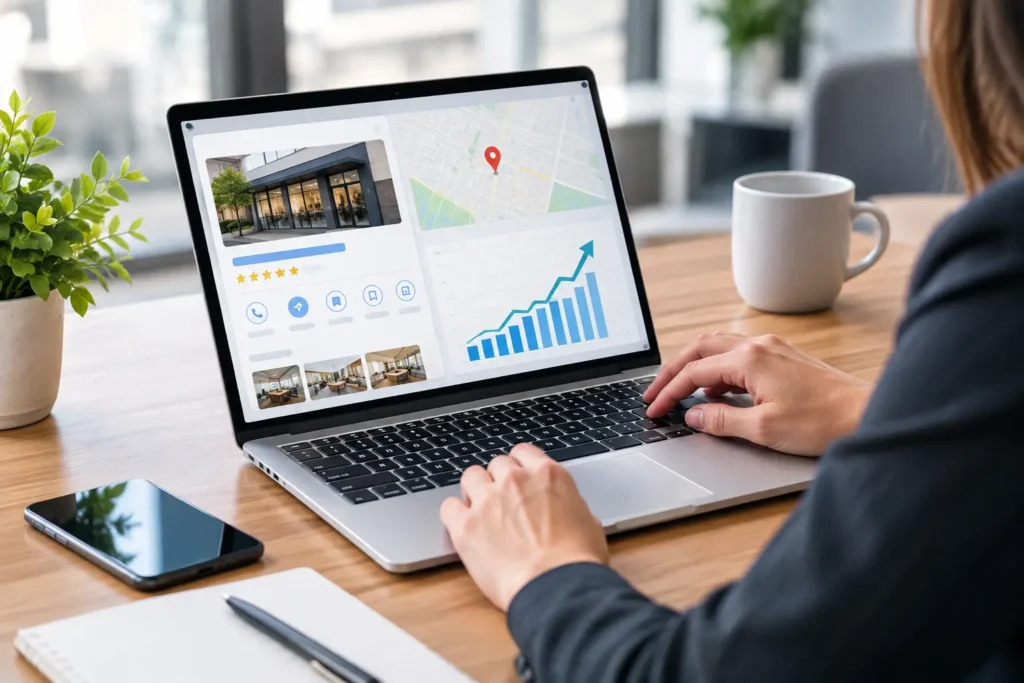
A customer searches for “plumber near me”, “best café in Hove” or “web designer Brighton” when they need an answer quickly. Before they visit a website, they often see Google Maps and the local business listings. That is why optimising Google Business Profiles is one of the most practical ways for a local business to earn more visibility, trust and enquiries.
Your profile is not simply an online directory entry. It is a working sales asset that shows potential customers where you are, what you offer, when you are available and why they should choose you. A complete, well-managed profile can help a small business compete with larger firms without relying on a large advertising budget.
Why your Google Business Profile affects local growth
Google uses a combination of relevance, distance and prominence when deciding which businesses appear in local search results. You cannot change a customer’s location, but you can make your business easier for Google and potential customers to understand.
Relevance comes from accurate categories, services, descriptions and updates. Prominence is built through reviews, recognised business information and a credible wider online presence. A professionally built website supports this work too, particularly when its service pages, contact details and local information match the profile.
For a Brighton shop, Hove tradesperson or UK service business working across several areas, the commercial benefit is straightforward: stronger local visibility gives more qualified people a route to call, request a quote, book or visit. The goal is not to attract every searcher. It is to appear clearly for people who are likely to become customers.
Start optimising Google Business Profiles with the basics
The foundation is accuracy. Claim and verify your profile, then complete every relevant field with the same care you would give a brochure or shop window. Use your real business name, not a version stuffed with locations or services. Adding “Brighton’s cheapest electrician” to a name might seem tempting, but it can lead to edits, suspensions and a less trustworthy first impression.
Choose the most precise primary category available. A primary category tells Google what you are chiefly known for, while additional categories can reflect genuine supporting services. A restaurant that also offers takeaway should not present itself as a takeaway first unless that is the main business. A web consultancy may offer web design, SEO and development, but its categories should reflect the services it actively delivers.
Add your telephone number, website, opening hours and address exactly as customers will use them. If you work from a home office or travel to customers, use the service-area settings rather than publishing a private address. Be realistic about coverage. Listing half the country may dilute the message and create disappointment if you cannot serve those enquiries.
Your business description should explain what you do, who you help and what makes your service useful. Keep it natural and specific. For example, a local builder might mention extensions, renovations and property improvements across Brighton and Hove, alongside an emphasis on clear quotations and reliable project management. That is far more useful than repeating “builder Brighton” several times.
Build out services and products
The services section is often underused. Add individual services with plain-English names and concise descriptions. This helps searchers understand whether you offer exactly what they need before they make contact.
A salon can separate cuts, colour treatments and wedding hair. A heating engineer can distinguish boiler servicing, repairs and installations. A consultant can describe website design, e-commerce development and local SEO. Only include services you genuinely provide, with pricing where it is clear and appropriate. For bespoke work, “request a tailored quote” is often more honest than a vague starting price.
Give customers proof before they contact you
People make quick judgements from profile photos. A weak logo, a blurry exterior image or a gallery of generic stock photography can make an otherwise excellent business look inactive. Use clear, recent images that reflect the real experience customers can expect.
For premises-based businesses, include the exterior, entrance, interior, team and popular products or completed work. Service businesses can show staff at work, branded vehicles, before-and-after projects and examples of finished results. Keep images well-lit and relevant, and add new ones regularly rather than uploading everything on the first day and leaving the profile untouched for a year.
Reviews are equally influential. Ask satisfied customers for a review shortly after a successful job, purchase or appointment, when the experience is fresh. Make the request personal and easy, but never offer incentives for positive feedback or pressure customers to use certain wording.
Reply to reviews promptly, including critical ones. A calm, constructive reply to a genuine complaint can reassure future customers that you take service seriously. Do not argue publicly or disclose personal details. If the review is unfair, acknowledge the concern, state the facts briefly where appropriate and invite the customer to continue the conversation directly.
Keep the profile active, not just complete
A profile needs ongoing attention. Check opening hours before bank holidays, update special hours, and make sure temporary closures are shown accurately. Few things lose local trust faster than a customer travelling to a business that Google says is open when it is not.
Posts can support timely promotions, new services, events and helpful updates. They are not a replacement for a content plan on your website, and they will not rescue a poorly structured profile. Used well, though, they give customers another reason to choose you and show that the business is active.
A café might post a seasonal menu, a retailer could highlight a local event, and a trades business may share a completed project with the client’s permission. Prioritise useful information over constant sales messages. The best update answers a customer’s likely question or creates a clear reason to get in touch.
Google also allows customers to ask questions. Monitor this area so that important queries are answered accurately. Leaving it unattended can allow incorrect public answers to become part of the customer journey.
Connect your profile to the rest of your online presence
Your Google Business Profile works best when it is supported by a website that gives visitors confidence to take the next step. The contact details, opening hours, business name and core services should be consistent across both. If a profile promises emergency call-outs but the website does not mention them, customers may hesitate and Google receives mixed signals.
Create clear pages for the services and locations you genuinely serve. Avoid copying the same paragraph across dozens of town pages with only the place name changed. Local content should be useful, accurate and connected to the way your business actually operates.
For businesses with more than one location, each profile needs its own correct address, telephone number, opening hours and local content. Do not create duplicate listings for the same office simply to target neighbouring areas. This can confuse customers and risks removal of listings.
Measure enquiries, not vanity metrics
A rise in profile views is encouraging, but it is not the final measure of success. Look at calls, website visits, direction requests, bookings and quote requests. Consider the quality of those leads too. Ten enquiries from people outside your service area may be less valuable than two enquiries that become profitable jobs.
Review performance monthly and look for patterns. Are customers finding you through broad category searches or by your business name? Which services receive the most interest? Are calls increasing after you add project photos or collect more reviews? These insights help you decide where to put time and budget.
It also depends on the business model. A local restaurant may focus on directions, menu interest and bookings. A B2B consultancy may care more about website clicks and detailed enquiries. The profile should support the action that matters most to your business.
Common mistakes that limit visibility
The most damaging problems are usually avoidable: an unverified listing, incorrect opening hours, duplicate profiles, missing categories, an outdated phone number or a profile with no reviews or recent photos. Another common issue is treating the profile as a one-off task rather than part of a wider marketing routine.
Do not chase shortcuts. Buying reviews, adding misleading keywords to your business name or creating false locations can cause far more harm than good. Local visibility is built through accurate information, consistent service and evidence that real customers value what you do.
A Google Business Profile will not replace a strong website, good customer service or a clear offer. It can, however, make all three easier to find. Give it regular attention, keep every detail honest and current, and use each customer interaction as an opportunity to strengthen the trust that turns a local search into your next enquiry.