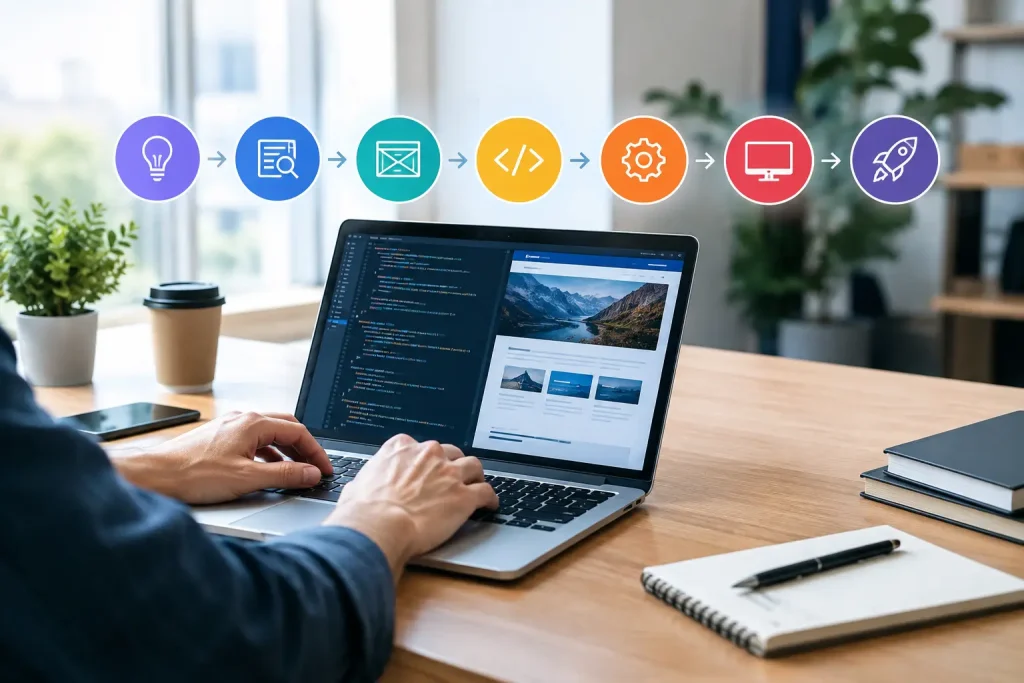
A new website should not begin with colours, fonts or a list of features. It should begin with the commercial question: what needs to improve? More enquiries, online bookings, local visibility, sales or credibility? A well-managed custom website development process turns that answer into a site built around the way your business actually works, rather than forcing your business into a generic template.
For small and medium-sized businesses, this structure matters. It keeps decisions clear, avoids expensive late changes and gives every page a job to do. Here are the seven stages that move a website from an initial conversation to a valuable business asset.
1. Start with goals, audience and priorities
The first stage is a focused discovery conversation. Before design begins, your web partner needs to understand what you offer, who your best customers are, where you operate and what makes you a better choice than nearby competitors.
A Brighton trades business may need more quote requests from homeowners. A restaurant may need clearer menus, bookings and location details. A professional service may need to build trust before a prospective client picks up the phone. These are different goals, so they should not be given the same website structure.
This stage also establishes practical priorities: your budget, launch date, existing brand materials and the people who will approve work. Being honest here is useful, not restrictive. A phased approach can be the right choice when the business needs a strong core website now and additional functionality later.
2. Plan the website around customer actions
A good-looking homepage alone will not deliver results. Once the goals are clear, the next task is planning the user journey: how visitors arrive, what information they need and what action they should take next.
This usually leads to a sensible page structure, such as service pages, an about page, case studies or portfolio work, contact details and useful supporting content. The right number of pages depends on the business. A local electrician with a tight service area needs a different structure from an online retailer with several product ranges.
At this point, search visibility should be considered too. That means identifying the services and locations potential customers use when searching, then assigning a clear purpose to each key page. This is not about repeating keywords unnaturally. It is about making it easy for search engines and people to understand what you do, where you work and why you are relevant.
3. Create content that earns attention and trust
Content is often the point where projects slow down, particularly when a business owner is busy running the business. Yet copy, images, reviews, pricing guidance and real examples are what help a visitor decide whether to contact you.
Clear website copy should answer the questions customers ask before they make an enquiry. What do you provide? Who is it for? What does the process look like? What makes your approach worthwhile? How can someone get started? Plain, confident answers are more effective than vague claims.
Photography and brand assets matter as well. Genuine images of your team, work or premises can create far more confidence than generic stock photography. Where new branding is needed, colours, typography and visual direction should be agreed early enough to keep the site consistent.
4. Design for clarity on every screen
Design is where the agreed strategy becomes visible. A bespoke website should reflect your character and market position while helping people find the information they came for quickly. For most SMEs, clarity beats cleverness.
A design stage normally begins with key page layouts and a visual direction. You should be able to see how headings, calls to action, service information, imagery and trust signals work together before the full build is completed. This makes feedback more specific and reduces the risk of major revisions later.
Mobile design is not an afterthought. Many local customers will first view your site on a phone while travelling, comparing suppliers or looking for a quick answer. Buttons need to be easy to tap, text needs to be comfortable to read and contact options need to be obvious. A site can look excellent on a large monitor and still lose business if its mobile experience is awkward.
5. Build the features your business genuinely needs
Development turns approved designs into a working website. This includes responsive layouts, contact forms, content management, security measures, performance work and any agreed functionality such as booking systems, online payments, product catalogues or integrations with third-party tools.
The advantage of a custom build is control. Your website can be shaped around your customer journey, brand and operating needs instead of being held back by an off-the-shelf layout. That said, custom does not mean adding every possible feature. Each feature adds cost, testing requirements and ongoing maintenance. The best choice is usually the one that makes life easier for customers and your team.
For example, an online booking tool is valuable when it saves staff time and gives customers a clear route to book. If every job needs a detailed conversation first, a well-designed enquiry form and direct phone option may produce better-quality leads.
6. Test before launch, not after complaints
A professional custom website development process includes thorough testing before the public sees the site. Pages should be checked across common screen sizes and browsers, forms should deliver enquiries correctly, links should work and important calls to action should be easy to find.
This is also the time to review speed, basic search setup, page titles, image descriptions, redirects from an old site and analytics tracking. If you are replacing an established website, redirects deserve particular care. They help retain the value of pages that may already be appearing in search results or shared across social media.
Business owners have a useful role here too. Check names, phone numbers, opening hours, service areas, prices and legal information closely. A technically sound website can still cause missed opportunities if a contact detail is out of date or a key service is described inaccurately.
7. Launch, measure and keep improving
Launch day is a milestone, but it is not the finish line. Once real visitors begin using the website, you can see which pages attract attention, where enquiries come from and whether people are completing the actions that matter.
The first few months are a valuable learning period. You may find that one service page attracts more organic traffic than expected, that customers repeatedly ask a question not covered on the site, or that a call to action needs to be clearer. These insights can guide practical improvements rather than guesswork.
Regular updates also protect your investment. Keep services, projects, testimonials, team details and business information current. Review website performance alongside wider marketing activity, including local search visibility, social campaigns and referral sources. A website works best when it supports the way you generate business rather than sitting separately from it.
What keeps a website project on track?
The strongest projects are collaborative without becoming complicated. Agree who provides content, who approves each stage and how feedback will be collected. Consolidated feedback is usually faster and clearer than multiple conflicting comments from different people.
It also helps to distinguish between essentials and future ideas. A clear launch scope protects the budget and keeps momentum. Valuable additions can be planned for a second phase once the main website is live and producing useful feedback.
At BONI Technology, the aim is to make this feel manageable: combining design, development and visibility planning so business owners have one supportive partner rather than several disconnected suppliers.
A custom website should give your business a clearer place to compete, communicate and grow. Start with the outcome you want from it, choose a process that keeps that outcome in view, and your investment has a far better chance of turning visits into real opportunities.