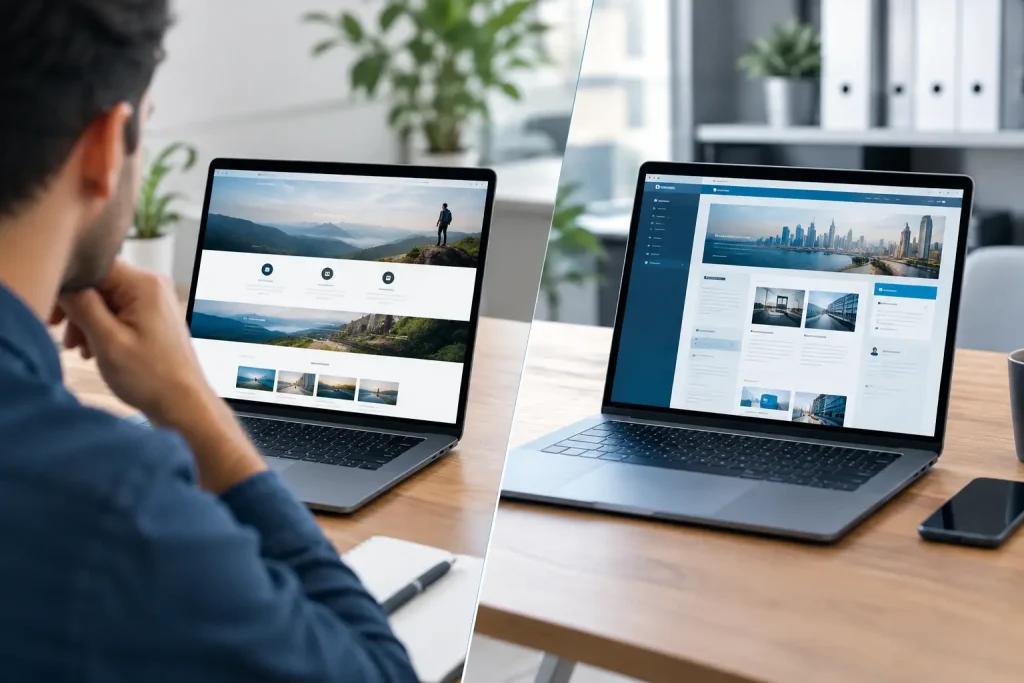
A website structure can affect far more than how your homepage looks. It influences whether customers can find you on Google, how quickly they understand what you offer, and how easily your site can grow with the business. When considering a single page vs multi page website, the right choice is rarely about following a design trend. It is about matching the site to the way your customers search, decide and get in touch.
For many small businesses, a polished single-page site can be an excellent starting point. For others, it can limit visibility just when the business needs more enquiries. The key is to build around commercial goals, not simply the number of pages.
Single page vs multi page website: the key difference
A single-page website places most or all of its content on one scrolling page. Visitors move through sections such as your services, about information, testimonials, portfolio and contact details without opening separate pages. Navigation links usually scroll the user to the relevant section.
A multi-page website separates information into dedicated pages. A typical service business site may include a homepage, individual service pages, an about page, case studies, a contact page and location pages where appropriate. Each page has a clearer, more focused job.
Neither approach is automatically better. A one-page website can be direct and persuasive when you have one clear offer. A multi-page site gives you more room to answer questions, target different search terms and support a broader range of customer journeys.
When a single-page website makes sense
A single-page website works well when the message is simple and the visitor has one main action to take. This could be booking a consultation, requesting a quote, registering for an event or learning about a new product launch.
For example, a local tradesperson offering one core service in a defined area may not need a large website at the outset. A clear page that explains the service, shows recent work, builds trust with reviews and makes calling or requesting a quote easy can convert well. It is also a practical option for a campaign landing page, where every section supports one offer.
The strength of this format is focus. The visitor does not need to decide which page to visit first. Instead, the content can lead them through a planned sequence: the problem, your solution, proof that you can deliver, and a clear call to action.
It can also be quicker to plan and more affordable to produce than a larger website, provided the content is kept concise. This does not mean it should feel basic. A bespoke one-page site still needs careful mobile design, fast loading, clear messaging and accessible contact options.
Where a single-page site can fall short
The limitation is space. As a business adds services, serves different customer types or wants to show more evidence of its expertise, one long page can become difficult to scan. Visitors may have to scroll too far to find the information that matters to them.
Search visibility is another consideration. Google can rank a single-page site, but one page has a limited ability to target several distinct services, locations or customer needs. If you offer web design, SEO, branding and ongoing support, for instance, a short section for each service is unlikely to explain each one as effectively as a dedicated page.
A long page can also make reporting less useful. With separate pages, you can see which services attract interest and which topics bring visitors from search. That makes it easier to improve content based on real behaviour.
When a multi-page website is the better investment
A multi-page website suits businesses with more than one service, more detailed buying journeys or ambitions to grow their organic visibility. It gives each part of the business a proper place rather than asking one homepage to do everything.
A builder might need individual pages for extensions, loft conversions, renovations and commercial work. A restaurant may need separate pages for menus, private hire, events and location details. A professional services firm may need service pages that explain its specialisms, sectors and approach before a potential client is ready to make contact.
Dedicated pages allow visitors to enter the site at the point most relevant to them. Someone searching for “emergency electrician in Brighton” has different needs from someone researching a full rewiring project. Separate, useful pages can address both without forcing either visitor through generic content.
Better foundations for SEO
For businesses that want to be found for more than their brand name, a multi-page site usually creates stronger SEO opportunities. Each page can focus on a particular service or subject, with a clear page title, useful copy and a relevant call to action.
This does not mean creating pages simply to include keywords. Thin, repetitive pages do not build trust and rarely perform well over time. The aim is to create a helpful page for a real customer question. Explain what is included, who the service is for, what makes your approach different and what the next step looks like.
A multi-page structure also supports future content. You can add case studies, FAQs, team profiles or local service pages as the business develops, without turning the homepage into a crowded brochure.
A clearer journey for different customers
Not every visitor is ready to buy at the same moment. Some need reassurance about price, process or experience. Others are comparing providers and want proof, such as testimonials and completed projects. A multi-page site lets people explore at their own pace while keeping the navigation clear.
The risk, of course, is overcomplication. Too many menu options, vague page labels and duplicated information can weaken a site. A larger website should still feel simple to use. Every page needs a purpose, and the navigation should help visitors move naturally towards an enquiry.
Cost, maintenance and growth
A single-page website generally requires less initial content and design work, so it can be a cost-effective choice for a newer business or a focused campaign. It may also be easier to maintain when the offer is stable.
A multi-page website usually needs a larger upfront investment because there is more planning, writing, design and development involved. However, it can offer better value over time if it helps the business win enquiries from several services or search terms. Starting too small can sometimes mean paying twice later, especially if the original site was not designed to expand.
The sensible approach is to build for the next stage of your business, not an imagined version ten years away. If you currently offer two services but plan to add more soon, a compact multi-page framework may be the right middle ground. You do not need fifty pages to create a site with room to grow.
Questions to ask before choosing your structure
Start with your customers. Are they looking for one clear service, or do they arrive with different problems and levels of knowledge? Consider what they are likely to search for and what information they need before contacting you.
Then look at the business itself. If you serve several locations, offer distinct services or rely on Google visibility for leads, separate pages are often worthwhile. If you are promoting one event, one product or one high-value offer with a direct response goal, a single-page structure may be more effective.
It is also worth considering the content you can support. A multi-page site needs accurate, useful information and regular attention. If you cannot explain a service properly yet, it is better to launch a focused site and develop it thoughtfully than to publish empty pages for the sake of page count.
Choose the structure that supports the next enquiry
The best website is not the one with the most pages or the most visual effects. It is the one that makes it easy for the right customer to understand your value and take action.
For a single offer with a clear conversion goal, one well-built page can do a great deal of work. For a growing business with multiple services and a need to improve search visibility, a multi-page website provides a stronger platform. At BONI Technology, the starting point is always the same: understand where your business is now, where you want enquiries to come from, and build a website that gives you a practical route to get there.